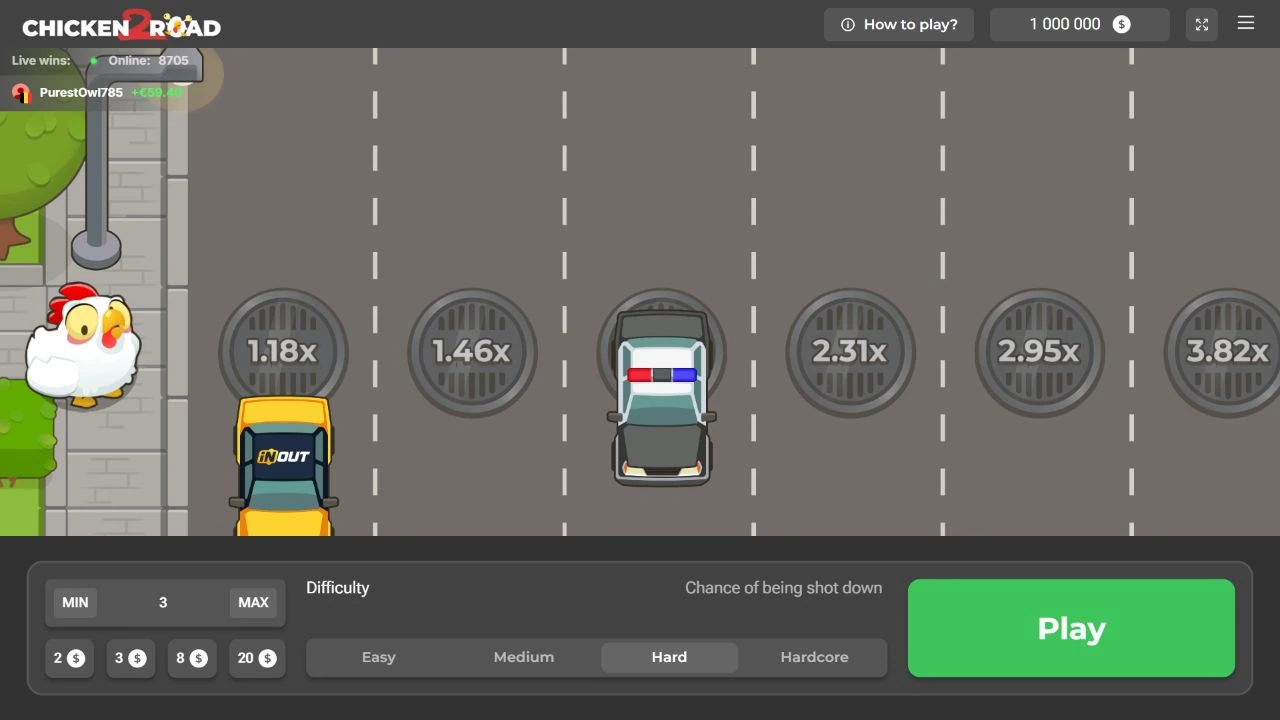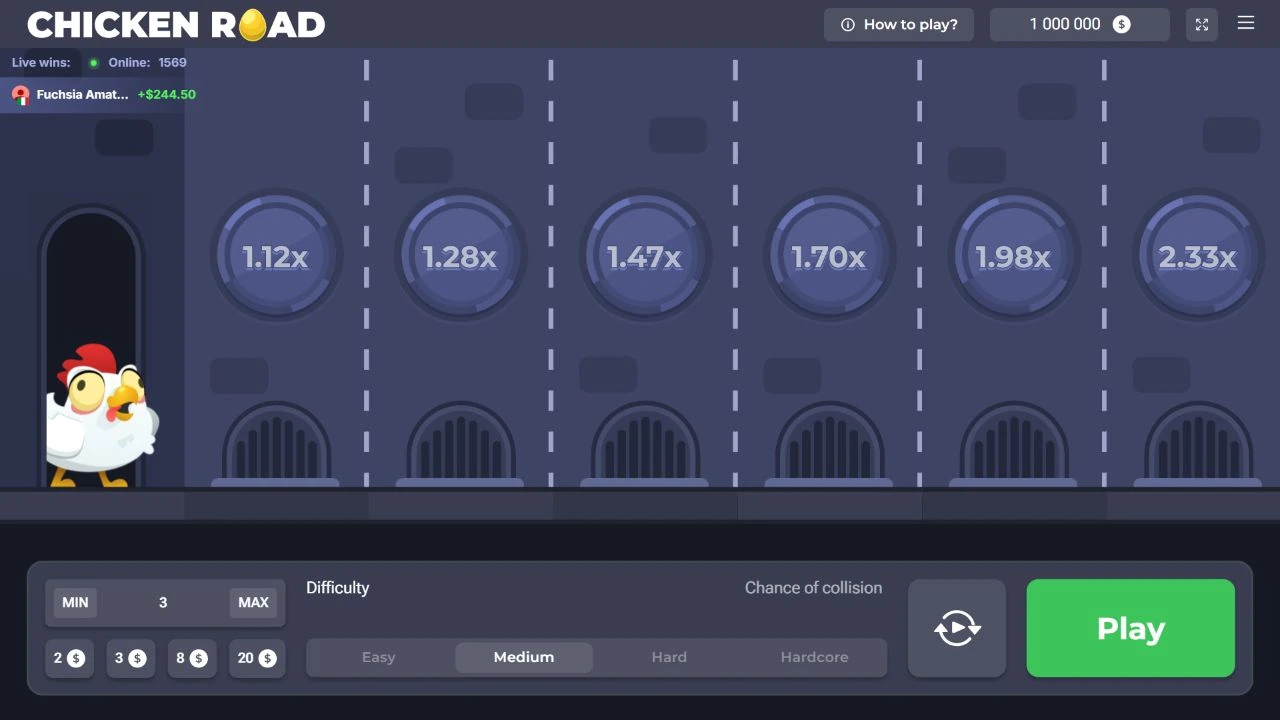
To start the original InOut Chicken Road, enter a stake, choose a difficulty and press Play. You then decide whether to take another step or collect the result. This guide explains the help reached through InOut’s original Chicken Road page; no active round was played during that check.
Look for Chicken Road and InOut Games in your game. If the title includes 2.0 or names a different provider, open that version’s rules instead.
Before a round
Open How to play? for the controls and Game rules for the limits. Find the stake field and difficulty selector, then check whether you’re using virtual demo credit or a real-money balance.
Your stake is the amount committed to the round. Read its currency and the limits in this game before interpreting a payout. Another demo’s limits may not apply to your account. For real-money play, set a budget you can afford to lose and stop when it is spent.
The InOut Chicken Road demo sits alongside the overview of the original game.
Difficulties and line counts
The original’s help, reread on 16 October 2026, lists these road lengths:
| Difficulty | Lines stated in the help |
|---|---|
| Easy | 24 |
| Medium | 22 |
| Hard | 20 |
| Hardcore | 15 |
These counts don’t give the probability of a successful step. A shorter road alone doesn’t make a mode safer or more profitable. Keep the counts for different games separate.
If your title says 2.0, use Chicken Road 2.0 game details.
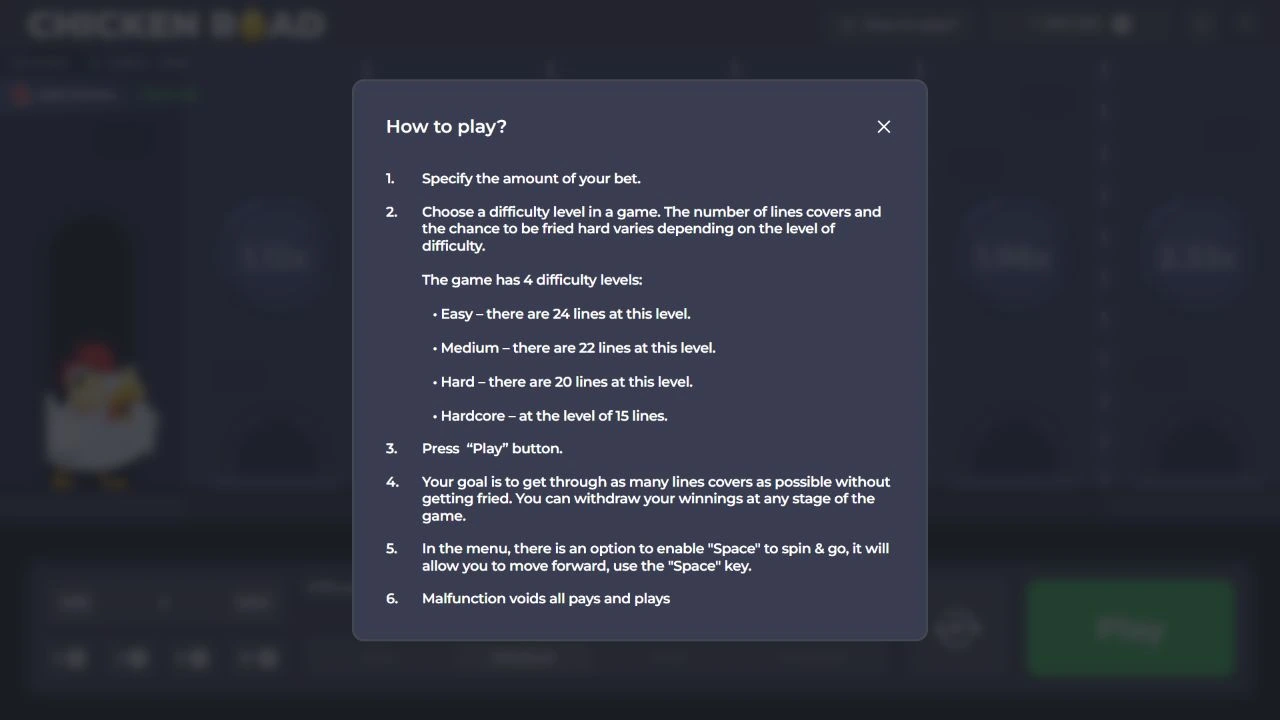
The sequence described in the instructions
- Set the stake. Check the amount, unit and limits shown in your game.
- Choose a difficulty. Read that mode’s conditions before starting.
- Press Play. This is the start control named in the help.
- Advance along the route. Progress involves risk; the rules don’t promise a safe path to the end.
- Collect or continue. The help allows collection during play. Another step leaves the round open to failure.
Use the current game’s controls and help for its cash-out action and supported input methods.

Collecting a result and ending the round
Cash out collects the current result and settles the round. Continuing exposes the stake to another failure. Reaching the final line is a different event from choosing to collect earlier, so read the final-line rule before attempting the whole road.
Game rules also says a malfunction invalidates games and payouts. This is a game condition; it doesn’t verify how a casino refunds money or restores an account.
To send money from a casino balance to a bank or wallet, you need a separate withdrawal request. Collecting a round doesn’t make that transfer, and virtual demo credit has no withdrawal value.
Multipliers, return and profit
A multiplier tells you how an amount is scaled. To understand the result, you need the stake, the multiplier and the game’s definition of the displayed payout. A return including your stake is larger than the net profit left after subtracting it. A maximum-win cap is another separate value to check.
Read the payout values for your chosen stake and mode. A table from another Chicken Road edition can’t replace the original’s rules.
Can a strategy identify a safe next step?
No safe next step or optimal cash-out point can be read from RTP. It describes theoretical return over a very large amount of play, not the result of one session.
The animation doesn’t establish that faster reactions or carefully timed clicks improve your outcome. A successful demo run can’t validate a profitable real-money strategy or prove that a casino pays withdrawals.