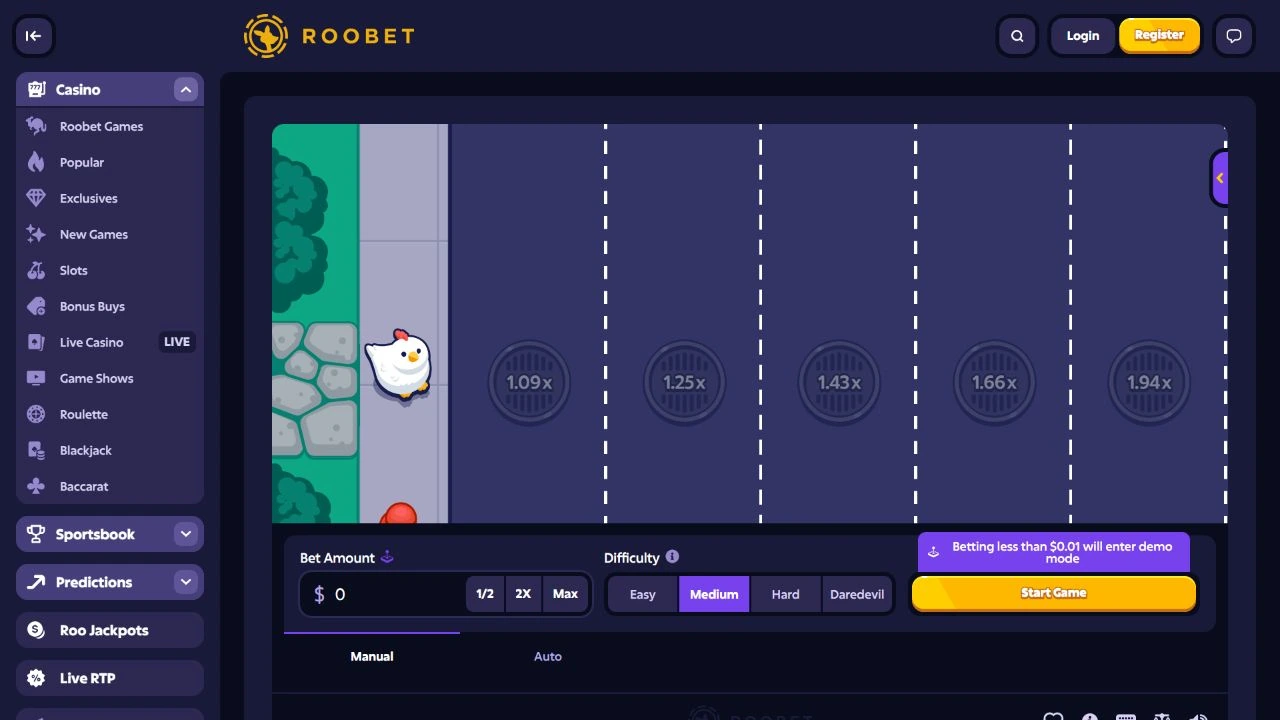
DEMO ACCESS
Chicken — demo availability
Stake’s Chicken information lists Demo Mode as unavailable. There is no public practice client embedded here.
Open the official game pageIn Chicken by Stake Originals, you advance across tiles and can collect the value reached. The official information table marks Demo Mode as unavailable. The access block therefore points to Stake’s game information, rather than showing another provider’s game as a substitute.
At a glance
| Detail | This game |
|---|---|
| Provider | Stake Originals |
| Game structure | Stake Originals progression game |
| Provider-stated RTP | 98% (theoretical) |
| Demo access | See the access explanation above |
The basic round
Stake says to choose a difficulty, set the stake and press Bet. Forward moves reach tiles with larger multipliers. Collection returns the stake multiplied by the occupied tile’s value; a broken tile or vehicle collision ends the attempt.
The four difficulty levels change volatility. Read the selected mode before using a multiplier ladder. One mode’s value doesn’t establish another’s payout or survival probability; use the instructions for your current settings.
Three decisions in Stake Chicken

- Choose the setup
Select the difficulty and set the stake before starting with Bet.
- Advance across tiles
Progress reaches larger multipliers; a broken tile or collision can end the attempt.
- Collect or continue
Collect takes the value of the occupied tile. Continuing keeps that value at risk.
Manual decisions and Auto mode
In Manual, you choose when to advance and collect. Auto offers settings for stake, volatility, jumps per round, round count, win/loss limits and stake changes after results. These automate bets rather than provide another source of winnings.
Check whether a limit applies to one round or the whole session. Increasing the next stake after a loss exposes more money; it neither cancels the old loss nor makes recovery due. Set a budget before turning on automation.
How to interpret the published return
The official card states 98% theoretical RTP and a 2% house edge. That doesn’t mean 98 of every 100 runs win. RTP concerns aggregate returns under the game’s model; win frequency is a separate measure.
For example, collecting a 5-unit stake at a stake-inclusive 2× returns 10 units, including the original 5. The displayed value isn’t a completed return until collected. This is an accounting example, not a recorded Stake round.
Why there is no embedded substitute
An embedded practice game must be the exact title and come from an authorised source. Stake’s Chicken information says no demo is available, and the recorded research established no public embeddable practice client. The access block links to the official information instead.
You can compare other games in the catalogue, but an InOut demo teaches InOut’s controls. Calling it Stake Chicken would conceal differences in provider, rules and return figures.
Common questions
Can I play a genuine Stake Chicken demo here?
No. No public demo is confirmed, and the official information explicitly marks Demo Mode as unavailable.
Does the chicken theme make this InOut’s game?
No. Stake Originals publishes this title with its own rules.
Sources and comparisons
The listed return comes from the provider or rules document, not a measured session result or a next-round prediction. The example assumes a stake-inclusive multiplier. Virtual credit in a demo, where offered, has no withdrawal value.
Compare Games and variants, or read InOut Chicken Road for that title’s separate rules. Official Stake references are in Sources & scope below.